(new articles also on my substack)
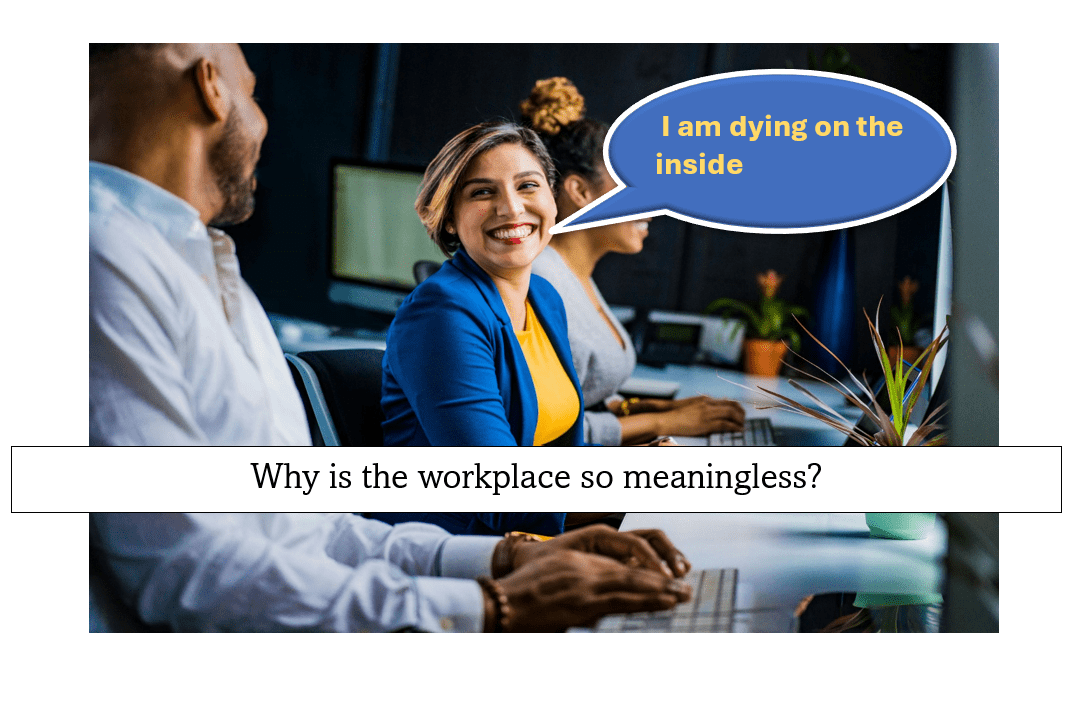
Why is work so meaningless?
I pondered this question last night as I examined the ways that I had painted myself into a corner in my life. The more I continue living in simplicity, a simplicity that many people would sacrifice their current lives for, the more I find myself fading. It is as though parts of myself are slowly becoming numb, while others are fighting the monotony by throwing themselves into fits of rage and sorrow that often feel unjustified, creating cycles of emotional denial, followed by inescapable episodes of sadness, guilt, fear, and hopelessness
My life though simple, was becoming increasingly more unsustainable. I wasn’t doing much: one job 32-40hours a week, and no other real responsibilities outside of myself. No children, healthy parents, consistent friendships, a cute (but small) apartment, paired with a constant feeling of dread hovering, humming lightly in the background. This was a life that I had fought so hard to find, and at times, a life that had felt unattainable to me. I questioned myself, often feeling as though the dread was just a lack of gratitude, a sign that my new life was spoiling me, twisting me into dissatisfaction, but there was a part of me that could not deny that something more was going on.
We have all been living in “unprecedented times” for so many years, it becomes hard to differentiate between whether the feelings of hopelessness we experience come from the tragic state of the world, or from the tragic state of our individual circumstances. In many cases the two are undeniably linked, but there have been times where, in my dissatisfaction I used the state of the world as a scapegoat for the failings of my day-to-day.
So what was it this time?
I started to scan the pillars of my life for imperfections. The only major pillar in my day-to-day is work, so I started analyzing my workday. Get to the office, sign-in, get my work computer, then pretend to enjoy my co-workers and tasks till lunch time. To avoid people, avoid the lunchroom and eat in my office alone, fake a smile at the team meeting, complete the redundant, poorly planned tasks that often require more than they are worth, then sign out, pack-up my computer and head home. What could be the problem?
Jim Carry once said the difference between depression and sadness is that sadness is just from happenstance, but depression is your body saying, “I don’t want to be this character anymore”, and though I could feel the need to drop the fake smiles and small talk, the need to maintain work relationships, and make enough money to sustain myself in an increasingly precarious economy, always seem to outweigh my need to let my freak-flag fly at the office. But then where should I put my freak-flag? Though I work in a care-field, my job feels meaningless most of the time, but pillars in my life, though stable, paled in comparison to the weight of the shadow left by the pillar of “financial stability”. This reality made me feel as though the only way to safety and happiness was to drink the Kool Aid of office-culture-professionalism. Though as I examine my life, I can see that I have been losing myself in 8hr increments, and it is starting to have a cost.
As I scanned the few pillars of my life I began to realize the simplicity, the lack of pillars, and the reliance on one ill-structured, unsatisfying pillar at the center, was molding me and shaping me into someone I did not recognize. These molds of “adulthood” that we were given have always felt like ill-fitting shoes to me, and the more I look around the more I wonder why we are maintaining them, and what would happen if we stopped, and took a look around to see if we were satisfied or forcing ourselves into shoes that were never ours to fill.
The character that I play when I get into the office is very specific, very inauthentic, and very exhausting, but I am keenly aware that, with the exception of one co-worker, if I let the character slip, the unspoken social norms of “the office” would be violated and I would be placed in an even more precarious position at work. At the same time, I cannot help but wonder, how much of this facade I can continue to maintain. There are only so many more conversations about the weather that I can have before I start thinking like that guy from the movie Office Space
There had to be another option than arson, so I continued to ponder. Find another office job? Become a vagabond drifter? Get a haircut with bangs? Or maybe this is a bigger problem.
I was listening to a podcast the other day about relationships and time, and in it they map out the time that you will spend on average with the various major relationship pillars of your life (Mel Robbins podcast clip). It explained that after the age of 25 your co-workers and your partner are the most present people in your life, for the majority of your waking hours, more so than your friends, born family, and even your children. As a single person, the prospect of spending the majority of my waking life doing meaningless things, talking about the weather, and contemplating arson was not something that I could see working long-term, especially as the world is falling apart around us all.
As I learn about the map of time, and become aware of the prevalence of “bullshit jobs” while I scour the internet for “lazy girl careers” and longer-term jobs for freaks who can’t do small-talk, I begin to wonder how we got to the point where are lives are dedicated to meaningless pretending at the office, rather than working to fix the many insurmountable problems that the world is facing daily. I used to be under the impression that, in “adulthood” we would be doing significant things, fixing problems, teaching wisdom, providing meaningful care, not avoiding co-workers in the bathroom, like a nerd in high school.
The more I look around the more It seems to me that all of the forms of life-stability that get promoted generally involve keeping busy, fixing nothing, self alienation and a general lack of responsibility to the world around us, as we watch the problems pile up. As a millennial -genz cusp, I know we have a want for change and willingness to stand up to injustice, but it feels as though the limited spaces that have been shown to us for creating meaning and fixing problems, all come at the cost to our individual stability.
As I said, I have no real responsibility outside of myself, no one to fix problems for, teach wisdom to, or provide meaningful care for, and I am beginning to think that that is a part of the problem. As I realize that I am in “adulthood”, though my personhood still feels aligned with that of a “young person”, looking for a manual on “how to adult” that I never received, I feel more that, as an adult, I must have more options than these ones, more power than this, and more ways to create a world worth living in, outside of copying the lives of those, like me formally, who pretended to enjoy the lunchroom conversation.
When I figure out how to use that power, I’ll let you know!
 ByAnotherName